
There's a common narrative that insurance companies are actively abandoning long-term care insurance, and that rates are spiraling out of control as a result. It's a story worth correcting, because the real shakeout in this market happened a long time ago, and understanding why makes the current landscape much easier to trust.
Rewind to 2000
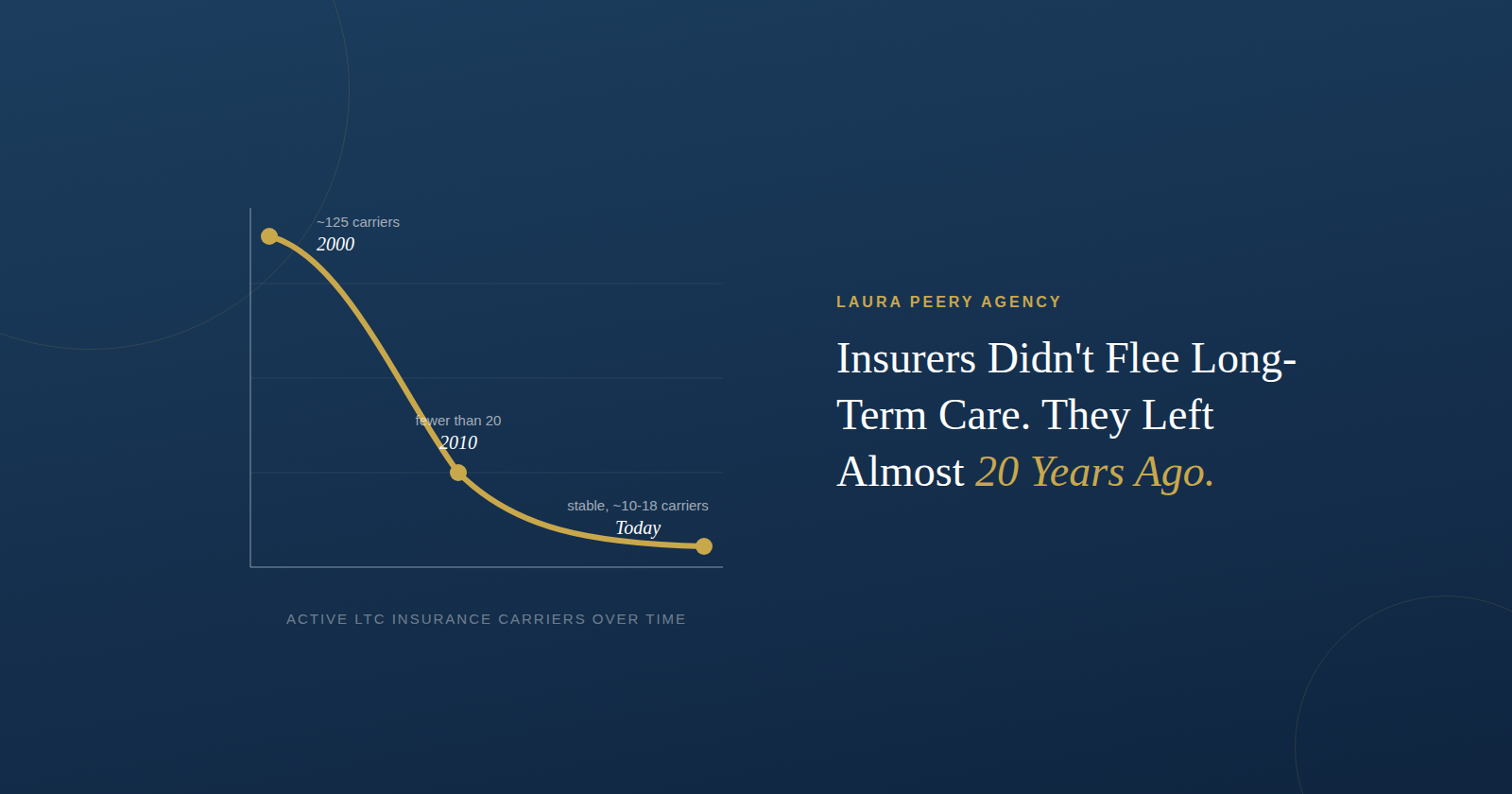
In 2000, roughly 125 insurance companies were selling long-term care insurance nationally. Pricing was aggressive and competition was high. By 2002, that number had already dropped to around 104, and a much larger shift was underway.
That same year, regulators introduced the Rate Stability Regulation, which states adopted individually over the following years, starting with Idaho in 2001. The regulation fundamentally changed the incentives behind how insurers priced their policies. Previously, a company could price a policy low to win business, and if that pricing turned out to be inadequate, it could simply request a rate increase later, passing that cost on to policyholders. The Rate Stability Regulation removed most of the profit incentive from that approach. Insurers were now required to build a margin for error into their initial pricing, and if a rate increase was still needed down the road, the profit allowed on that increase was capped.
In effect, underpricing stopped being a viable business strategy. Many companies that had built their long-term care business around that model decided the numbers no longer worked, and they left the market. By the end of the decade, fewer than 20 companies were still actively selling long-term care insurance, and by the early 2010s, that number had fallen to close to a dozen.
What's Actually Happening Now
Since that period, the number of active carriers has remained relatively stable, generally staying somewhere between 10 and the high teens. This isn't a market in ongoing decline. It's a market that already went through its correction and has held steady for well over a decade.
It's also worth noting that in many states, there are still more companies selling long-term care insurance than there are selling standalone disability insurance. Long-term care insurance didn't disappear. It consolidated around a smaller group of carriers that priced the risk correctly from the start.
Not Selling Is Not the Same as Going Bankrupt
There's an important distinction that often gets lost in this conversation. A company that stopped selling new long-term care policies is not the same as a company that failed. According to data compiled by LTC Shop, an insurance agency that specializes in long-term care insurance, of the 173 companies that have sold long-term care insurance over the years, fewer than six have ever gone through liquidation.
Those few companies that did fail generally shared a common thread: poor financial ratings at the time they were selling policies. Combined, they accounted for less than 2% of long-term care insurance policies in force. And even in those cases, the claims did not simply disappear. State guaranty associations stepped in and have continued paying those claims.
Choosing to stop selling new policies is a business decision. It is not the same as insolvency, and it should not be confused with one when evaluating the long-term care insurance market as a whole.
Why This Matters If You're Shopping for Coverage
If you're considering long-term care insurance today, you're not entering a shrinking market run by unstable carriers. You're looking at a market that already corrected itself, made up of companies that generally understand this risk far better than the ones that exited two decades ago. That doesn't mean every policy or carrier is the right fit for your situation, but it does mean the instability many people associate with long-term care insurance is a legacy story, not a current one.
Let's Talk About Your Options
At Laura Peery Agency, a Ramsey-Trusted Pro team, we work with the carriers that are actually built for today's long-term care landscape. We'll walk you through your options and help you understand what you're actually buying, and from whom.
Ready to see what long-term care could cost in your situation, and how to plan for it?
📅 Book a free consultation: LauraPeeryAgency.com/book-online
📧 Email us: Laura@LauraPeeryAgency.com | Tom@LauraPeeryAgency.com | Roger@LauraPeeryAgency.com
📞 Call us directly: Laura: (321) 848-3838 | Tom: (321) 917-2521 | Roger: (321) 848-1377
Written by Aden Johnson,
Long-Term Care Specialist
Sources: America's Health Insurance Plans (AHIP) 2000/2002 insurer surveys; National Association of Insurance Commissioners (NAIC), "The State of Long-Term Care Insurance" (2016); NAIC Long-Term Care Insurance Model Regulation (#641)


