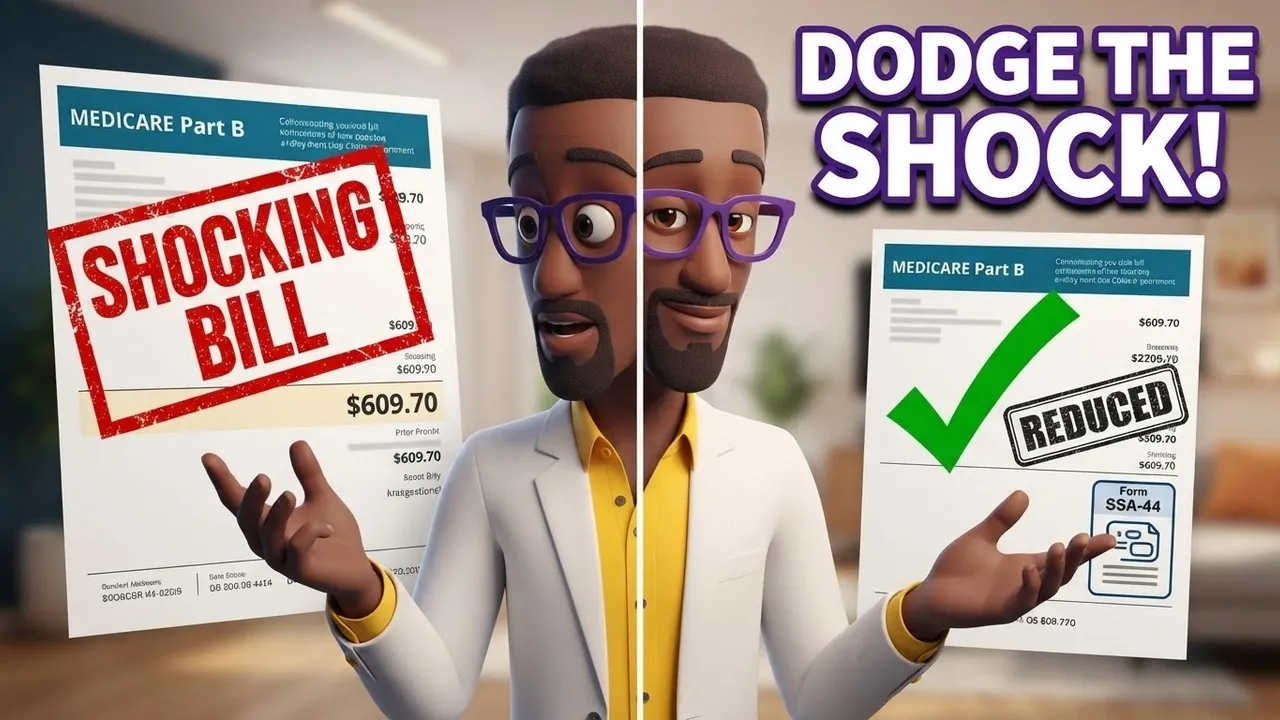

So, you just came back from the mailbox. You opened that crisp, white envelope from Medicare, saw the bill for your Part B premium… and your jaw just about hit the floor.
You were probably told to expect a premium of around two hundred bucks a month. But the piece of paper in your hand says you owe six hundred, maybe eight hundred, maybe even over a thousand dollars.
Before you grab the phone to give someone a piece of your mind, just take a deep breath. I want you to know this is incredibly common. It’s called “sticker shock” for a reason, and it does *not* mean you’re stuck paying that crazy amount forever. You are not alone in this, and more importantly, you have options.
In this post, I’m going to break down exactly what that bill means, line by line. We’ll uncover the hidden reasons it's so much higher than you expected. And then, I’m going to show you how to fight back against those extra fees, including the exact form you need to potentially slash that bill right back down to size.
Section 1: Deconstructing the Bill - The "Why" Behind the Shock
Alright, let's solve this mystery. The first step to fixing the problem is understanding it. That shocking bill is usually high for a couple of main reasons, and the first one is just simple timing.
The First Culprit: Quarterly Billing
If you’re enrolled in Medicare but you’re *not* yet collecting Social Security or Railroad Retirement Board benefits, Medicare doesn’t bill you monthly. They bill you quarterly. So, that first bill you get isn't for one month of coverage; it’s for three. Once you do start receiving Social Security or RRB benefits, your premiums will typically be deducted monthly from those payments, but until then, you’re on the quarterly plan.
Let’s do some quick math. The standard Medicare Part B premium for 2026 is $202.90 a month. So, multiply that by three…
$202.90 times 3 is $608.70.
Suddenly, that number on your bill starts to make a little more sense, right? It’s not a mistake; it’s just three months of premiums bundled together. This catches so many people off guard, but it's just a logistical quirk.
But maybe you're looking at your bill and thinking, "Nope, my bill is WAY higher than that." And that brings us to the second, more complicated reason for your sticker shock.
The Second Culprit: IRMAA, the Secret Surcharge
This is the big one. This is the part that can make your premium double, triple, or even more. It’s a program called the Income-Related Monthly Adjustment Amount, or as we call it, IRMAA.
What is IRMAA? It’s an extra charge that higher-income beneficiaries have to pay on top of their standard Part B premium. And here’s the detail that trips everyone up: "high-income" is determined by your tax return from **two years ago**.
Let me say that again because it's the most important piece of this puzzle. Your 2026 Medicare premium is based on the Modified Adjusted Gross Income, or MAGI, you reported on your 2024 tax return. The Social Security Administration (SSA) gets this info directly from the IRS. If your income from two years ago was above a certain threshold, they automatically tack on an IRMAA surcharge.
For 2026, if you filed your 2024 taxes as an individual with income of $109,000 or less, or as a married couple filing jointly with $218,000 or less, you’re in the clear. You’ll pay the standard $202.90 premium.
But the moment you go over that line—even by a dollar—the surcharges kick in.
* If your individual income was between $109,001 and $137,000, your monthly premium jumps to $284.10.
* If your income was between $137,001 and $171,000, your premium becomes $405.80 a month.
* From $171,001 to $205,000, it’s $527.50 a month.
* From $205,001 up to $500,000, your premium is $649.20 a month.
* And for individuals who earned over $500,000 two years ago, the premium hits the ceiling at a staggering $689.90 per month.
Now, there's a critical exception to be aware of: if you're married but file your taxes separately, the income thresholds are much lower and the penalties are steeper, starting if your income was over $109,000.
And remember, if you're billed quarterly, you have to multiply these amounts by three. Someone in the highest tier could get a first bill for over $2,000! It’s no wonder people are shocked. Many new retirees are being charged based on the full-time salary they earned two years ago. The system doesn't automatically know you stopped working; it only sees that old income data.
The Third Culprit: The Lifelong Late Enrollment Penalty
There’s one more charge that can inflate your bill, and it's the most avoidable, yet it’s permanent: the Late Enrollment Penalty.
If you were eligible for Part B but didn’t sign up during your Initial Enrollment Period, and you didn't have other *qualifying* health coverage (like from an active employer), you get penalized. This isn’t a one-time fee. It is a permanent surcharge added to your monthly premium for as long as you have Part B.
For every full 12-month period you could have had Part B but didn’t, your premium goes up by 10% of the standard premium. So, if you waited two years to sign up, your monthly premium will be 20% higher. Forever. Based on the 2026 standard premium, a two-year delay adds an extra $40.58 to your bill every single month. It might not sound like a fortune, but over 20 or 30 years in retirement, that’s thousands of dollars down the drain.
Section 2: How to Fight Back and Lower Your Bill
Okay, so now you get *why* your bill is so high. It's likely a mix of quarterly billing and, more importantly, an IRMAA surcharge based on old income. Now for the good part: let's talk about how to fix it.
Solution #1: The IRMAA Appeal with Form SSA-44
This is your most powerful weapon, especially if your income has recently dropped. You are not stuck paying a premium based on what you earned two years ago. You can appeal it.
The Social Security Administration has a process for this, and it all comes down to one document: Form SSA-44, the "Medicare IRMAA Life-Changing Event" form.
This form lets you report that your income has gone down because of a specific, qualifying "Life-Changing Event." If the SSA approves your appeal, they will recalculate your premium based on your *current*, lower income.
So, what counts as a life-changing event? The SSA is very specific. The most common ones are:
* Work Stoppage or Reduction: This is the big one for retirees.
* Marriage, Divorce, or Annulment
* Death of a Spouse
* Loss of a Pension
* Loss of Income-Producing Property (due to circumstances beyond your control).
* An Employer Settlement Payment
If one of these has happened to you, you should file Form SSA-44. It’s not enough to just say you retired; you have to show that the event caused a significant drop in your income and provide proof. This might be a letter from your old employer, a death certificate, or a divorce decree, along with evidence of your new, lower income. If your appeal is approved, your premium will be lowered, and you could even get a refund for the surcharges you’ve already paid. This one form can literally save you thousands of dollars a year.
Solution #2: Fixing Your Payment Schedule with Medicare Easy Pay
While you’re dealing with the IRMAA appeal, you can solve the quarterly billing headache. That big, lumpy bill every three months can be a budgeting nightmare.
The fix is a free service called Medicare Easy Pay. This is an automatic payment program that pulls your premium from a checking or savings account on the 20th of each month. It switches you from that clunky quarterly schedule to a predictable monthly payment. It takes about 6 to 8 weeks to get going, so you’ll still have to pay that first big bill, but after that, it’s smooth sailing.
Solution #3: Avoiding the Penalties in the First Place
This last tip is for everyone watching who isn't on Medicare yet. The best way to deal with the Late Enrollment Penalty is to never get it.
Circle your Initial Enrollment Period (IEP) on the calendar. It's the seven-month window around your 65th birthday—starting three months before, including your birthday month, and ending three months after. Signing up then is the safest way to avoid penalties.
If you work past 65 and have health insurance from that job, you can use a Special Enrollment Period (SEP) to delay Part B without a penalty. But be careful! Not all coverage protects you. Things like COBRA or a retiree health plan do not count as qualifying coverage to avoid the Part B penalty. When you do stop working or lose that employer coverage, you’ll have an eight-month window to sign up penalty-free.
Conclusion
Let’s do a quick recap. That shocking bill is probably high for two reasons: you’re being billed for three months at once, and you’ve been hit with an IRMAA surcharge based on your income from two years ago. The best way to fight the surcharge is to file Form SSA-44 if you’ve had a life-changing event like retirement.
Getting a handle on your Medicare bill is the first step to controlling your healthcare costs. It can feel like a lot, but you now have the tools to challenge those fees and make sure you’re only paying what you're supposed to.
To help you get started, I’ve put together a free resource guide. It has direct links to the 2026 IRMAA charts, a link to download Form SSA-44, and a guide for setting up Medicare Easy Pay. You can find the link for that guide in the description below.